Tuesday, 29 September 2009

THE LATEST IN AZOGIRES

This past Month has flown by so fast it's unbeliveable; so many things happened, so many friends visited, and I, as always, had no time to record any of these wonderful moments.


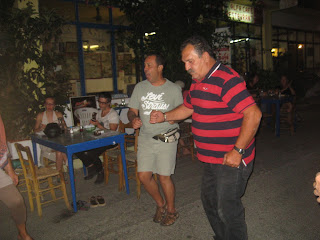
Events such as Pops' birthday party. Pops is from England, he visits us every year and this time he was 76 years of age. But he still has the heart of a youngster and friends of all nationalities came to wish him a long and prosperous life - and they all made a promise to be here next year for Pops' 77th birthday.


The other most astonishing thing that my eyes witnessed was an 82 year old gentleman by the name of JOHN TALLECK walking up the 7 Kilometers long Azogires - Paleohora road together with his lovely wife CRIS MORRISON, complete with backpacks under the hot sun. This Dude was hiking up the Hill like a twenty year old! I am telling you, even I could not keep up with him? And at my advanced age, I know that's a worry.


Tuesday, 8 September 2009

The Russian Church


How did a Russian Church end up in Azogires?

The church was built in memory of a man who, before his death, had requested it be built in its present location. The church was designed by the man’s brother and his family arranged for his wishes to be fulfilled and the church built. The original plan was to call it Agios Eftixis but since there was already a church in the area with the same name, the local priest prevailed on the benefactors to change the name.

The priest persuaded them to adopt the current name for the church because while he had been visiting the grave of that saint in Euboia, where the body of the saint who died in 1740 is said to lie uncorrupted, he allegedly saw a “possessed” boy being cured. He says he saw the boy being brought to the tomb of the saint and while the boy was put on the grave he started floating a few centimetres above the floor and acting in a crazy manner. When the boy left the church he was fine and cured. On the strength of this the priest persuaded the family to name the church after St John the Russian.

More details of St John the Russian can be found here:

http://www.roca.org/OA/39/39g.htm


Although there was apparently no record of there previously having been a church on the site of the Russian church, during the construction three graves were unearthed, one of which was believed to have been a Byzantine grave with a plastered interior.

Saturday, 29 August 2009

Latest Tavli competition -


8 different nationalities were represented in this years contest held on Sunday 23 August.

The tournament, held in commemoration of Andy Millar, a former resident of Azogires, started on 1 pm finished at 8 in the evening. Competition was intense for the first prize of a trophy, to be held by the winner for a year, and additional prizes of local olive oil and raki.

After a fiercely fought contest, during which Eftihis (Lucky) Koukoutakis failed to live up to his name and, in his own words, "…got my ass kicked: twice”, the first prize went to Sakis, shown above, from Lebanon with the second and third prizes going to Ildiko from Hungary and Martin from Germany respectively.

Lucky’s donkey is recovering well; the rumoured assault on him being the result of a minor failure of English/Greek translation.

Sunday, 26 July 2009

A VISIT FROM AN OLD FRIEND


I had a surprise visit from a known Musician and a good Friend from the past, Mr Georg Lauterbook from Austria. Whe he visited our village 6-7 years ago he spent hours and hours picking up trash and cleaning up the Cave of the 99 Holy Fathers, without anyone asking him to and at his own cost. He is the first volunteer and Gentlemen that I ever met.

Mr Georg Thank you; Thank you for your love and respect towards my village. Every time you visit I know you are not just here for a vacation, I know you will spend some of your time picking up trash and making Azogires more beautiful. You can listen to some of Mr Georg's music on the sites below
www.myspace.com/therandomharmonies
www.myspace.com/psychotropicaustria
www.myspace.com/leukocyterio

Saturday, 18 July 2009

St George's mysterious companion

St George in Agios Georgios, Azogires

St George in Agos Georgios/Agios Nicholas, Anidri

The story of St George and the dragon is well known and he has two churches dedicated to him in Azogires. However, if you look at the pictures above, the upper picture, the icon of St George in of Agios Georgios/Agios Nicholas in Anidri, differs from the lower picture, the icon of St George in the church of Agios Georgios in Azogires, the church just down the hill from the Alfa Cafenion. The Azogires icon, as is the case with the vast majority of such icons, doesn’t have the young boy with the jug or glass in his hand, riding on the horse behind St George. Who then is this mysterious figure?

According to Piotr Grotowski at

http://www.icon-art.info/book_contents.php?book_id=84

there are three versions of the tale of the young boy.

Version 1)

During their invasion of Paphlagonia (on the southern coast of the Black Sea) the Agarenes (Arabs) took many people into captivity, among them a young boy who was a servant in the church of St. George in Phatris. Some of the prisoners were killed, the rest turned into slaves. The boy was of such beauty that he was chosen as a servant for the Arabian ruler. As he rejected the offer to become a Muslim, he was sent to work in the kitchen. In his misfortune the poor boy prayed to Saint George. Once at evening, when he was lying in bed, he heard a voice coming from the yard and calling his name. The boy opened the door and saw a rider who caught him and placed behind himself on the horse. Then the steed rushed forward and started to gallop. The rider brought the boy to a certain building, and then disappeared. The exhausted youth fell asleep and next morning was awakened by the people, who were dismayed because his Arabian clothes suggested the presence of enemies. The boy recognised those people as monks. As it transpired, he had been brought to Monastery of St. George. All of them went to a church to offer a thanksgiving prayer to God for saving the youth.

Version 2)

The cult of Saint George was propagated in Paphlagonia, especially in the place called “Potamos itoi i Oikiakos”, where a church of the saint was situated, to which numerous pilgrims were coming. A soldier lived there, named Leon. He and his wife Theophano revered this martyr, and when their son was born, they named him George. When the boy had grown up, his parents entrusted his education to those who maintained the shrine. When Bulgarians, Hungarians, Scythians, Medes and Turks threatened the northern borders of the empire, the emperor Phocas recruited an army. Leon, who was too old to become the commander of Byzantine forces, sent his twenty-year-old son George in his stead. Before the expedition started, they went to the church where George had been baptised, and the father invoked the protection of the saint patron for his namesake. The Byzantine army was defeated. Those soldiers who were not drowned at sea nor killed by famine were taken as prisoners. Young George, who was captured by the Bulgarians, was so handsome that their ruler made him a steward and kept the boy in his residence. Meanwhile the worried parents of the boy prayed to Saint George to liberate their child. His mother in particular was pained by the loss of her son, of whom she was reminded whenever she met boys his age. The feast of the martyred saint came and the parents of the prisoner went to the church for evening liturgy, following which they invited their relatives and friends for the traditional supper. However, sadness reigned during the supper, as everybody remembered the fate of the host's son. The same evening, the Bulgarian ruler ordered the boy to bring water for hand-washing during the supper in the palace. While the boy was going downstairs with a jug14 of hot water and a towel, the saint appeared to him on a white horse, ordered the boy to sit behind him, and immediately transported the youth to his home in a miraculous way. At first the parents of the boy fainted, when they saw the Bulgarian clothes and steaming jug while the terrified guests started to shout. Only after a few minutes, when all of them recognised Leon's son, they started to celebrate because of his miraculous return, and drank the delicious, still hot water from the jug. The prayers of thanksgiving in the church of Saint George lasted for the whole night. George offered the vessel, which he had brought from the Bulgarian court to serve as a chalice during mass. When he grew up he told his story many times.

Version 3)

In Mytilene on Lesbos there was a church dedicated to Saint George. While planning the attack against this island, the Arabian [“Agarinoi”] pirates from Crete chose the day of the feast of the saint, when all the inhabitants were together in the church to celebrate the liturgy. Amongst those taken into captivity was the young and very handsome son of a widow. The Emir of Crete made him his personal cupbearer. For a whole year the despairing mother prayed to St. George hoping to get her son back. With particular fervour she asked the saint on his feast-day, in other words on the anniversary of her son's kidnapping by the Saracens. At such a moment, the boy was giving a glass of wine to the emir. Unexpectedly St. George appeared on a white steed, caught the boy and brought him to his mother's house. All the inhabitants of Mytilene revered the saint for his miraculous rescue of the boy.

Although the third version is known only from late manuscripts, the facts described in it can be related to the situation on the islands of the Aegean Sea in the 9th or 10th centuries. Stavros Mihalarias and Robin Cormack think that Arabian rule on Crete (824 to 961) and also their attack on Lesbos (about 867) would naturally have been included in the story of the boy's capture

Also on Crete, which soon after Cyprus became a Western colony (after the Fourth Crusade Boniface of Montferrat, who has been granted Crete, sold it to Venice) the subject of St. George saving the youth from captivity appears in the middle of the 13th century. One of the oldest examples can be seen in the fresco from St. George's church in Kantano Selinas, which was painted during the 1240s. The next two examples from this island are dated from the turn of the 13th and 14th centuries. The first of them survived on the North wall of the naos in the church of the Panagia in Saitoures (near Rethymnon) ascribed to circa 1300. Among mounted military saints is depicted St. George with the boy holding a vessel. In his right hand the warrior keeps a lance with a small pennon beneath the top. This motif as an element of iconography of holy knights appears undoubtedly under the influence of western chivalric culture. A bit later is the representation from St. George's church in Komitádes near Chora Sphákion, in western Crete. The fresco was painted by Ioánnis Pagomenos in 1313/14. Though this painting is not in its original condition, it is still possible to identify the sea with swimming fish under the belly of the horse and a boy sitting behind St. George's back.


So there you are.

Tuesday, 30 June 2009

End of June flowers


The temperature is almost a high as it is in London at the moment (Paleochora today, 30th June, max 28.5 degrees; west London max 30.2 degrees) but there's more flowers here than there are at the Met.Office station at Heathrow!


Sunday, 21 June 2009

Flowers of Azogires


Sorry for the bit of a delay since the last post but here we go...a selection of the local flowers currently to be seen in and around Azogires.

Help to identify them from any botanists out there would be most gratefully received!